
What is Bullying? Camp Wannaklot Teens Take on the Question
Horizons in Hemophilia, October 2013
By Cathy Hulbert, LCSW, HoG Social Worker
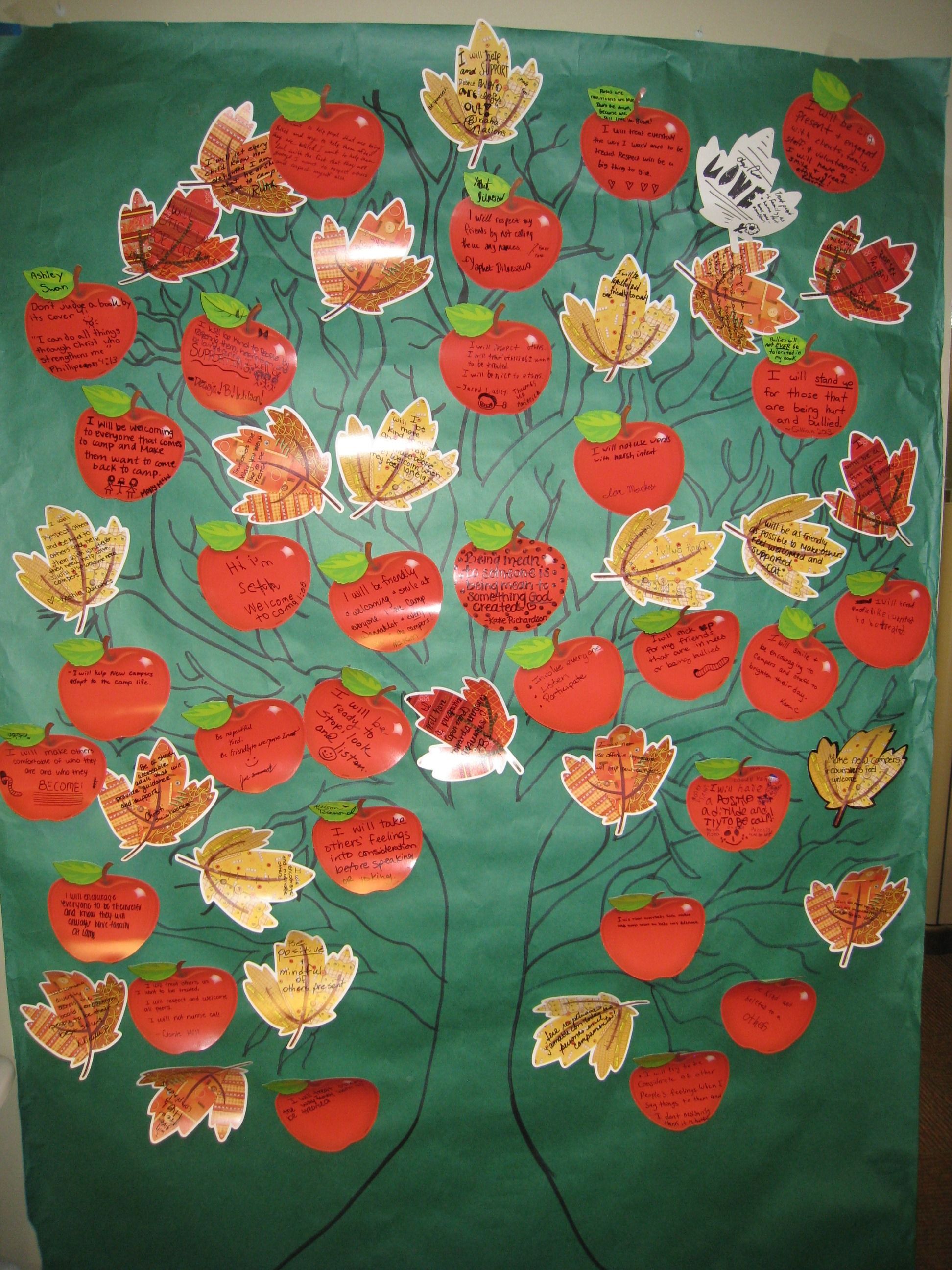 Bullying might be a growing problem in our culture, but teens involved with Hemophilia of Georgia are taking steps to grow something really good to take its place. Together with HoG staff, they have created a big paper tree that has “leaves of kindness.” Teens ages 13 to 18 worked on the project during Teen Retreat earlier this year after talking about the potentially serious consequences of bullying. They are putting their heads together with Deniece Chevannes, HoG’s Health Educator, and Kim Wilson, HoG’s Camp and Activities Director. Some of these teens want to become true leaders in this area.
In the future, all Camp Wannaklot campers will have a chance to add their own leaves to the colorful compassion tree. They can add such statements as “I will treat people the way I want to be treated.” Or, “I will not pick on other people.” And they will hold each other to these personal pledges.
With the start of a new school year, many kids and teens will suffer from bullying. Would it surprise you to learn that bullying is considered a form of violence by those at the Centers for Disease Control and Prevention (CDC) who study this widespread problem?
Attack or intimidation with the intent to cause harm can be physical or psychological. It can range from punching to name-calling to spreading rumors, according to the CDC. All types of bullying can lead to serious safety and health problems for victims. Many victims of bullying suffer from such things as depression, anxiety, stress-related health problems, sleep disorders, learning problems, thoughts of self-harm and in some cases even suicide attempts.
You can follow this link to other helpful information provided by the CDC: https://www.cdc.gov/violenceprevention/pdf/bullying_factsheet-a.pdf.
It is obvious to almost everyone that punches are violence and that spreading malicious gossip is a form of bullying. But there are some things that are harder to label.
Most of us make judgments about other people’s lives from time to time. The judgments can be about how others talk, what they eat, where they worship, how they dress, what music they listen to -- even which kind of phone they have, according to health educators who met recently to discuss this. In addition, it is human nature to label people by groups – girls, boys, men, women, sexual orientation, ethnicity, skin color, type of bleeding disorders. But when the harsh words and behaviors begin, that is often the start of bullying that can become highly destructive.
One challenge for kids, teens and adults is to grapple with what actually equals hurtful behavior. In the case of teasing, jokes or rough play, there are actions or words that bother one person but might not bother another. Whether or not you are hurt by teasing and jokes can depend on who is behind them and what kind of relationship you have.
The key to teasing is whether the words and actions continue despite a person’s request for them to stop. Sometimes hurtful behaviors continue because one person is perceived as having more power, or being more popular, than the target. In such cases the victim might not seek help because they feel powerless or afraid that telling will make things worse.
Bullying can also be defined as “social exclusion,” a form of shunning that intentionally hurts another person by consistently leaving them out. Of course, there is gray area here, too. Not everyone is going to be friends. Personalities sometimes clash. When does it become bullying to avoid someone? The HoG teen group explored these issues and will keep talking about them in the hopes of making things better.
One of the most modern forms of bullying is known as “cyberbullying,” or “electronic aggression,” according to CDC literature. This includes hurtful actions through e-mail, chat rooms, instant messaging, texts, videos and pictures posted on websites.
It is also important to know that some people are both bully and victim. Being the target of bullying can damage self-esteem and create a desire to lash out at someone else. It is a complicated problem, but talking about it and pledging to change things is a big step in the right direction!